
The Extradimensional Metaphysics of the Transfiguration: A Scientific and Theological Exploration
Extradimensional Physics and the Metaphysical Immortality of Jesus - Matthew 17:1-3

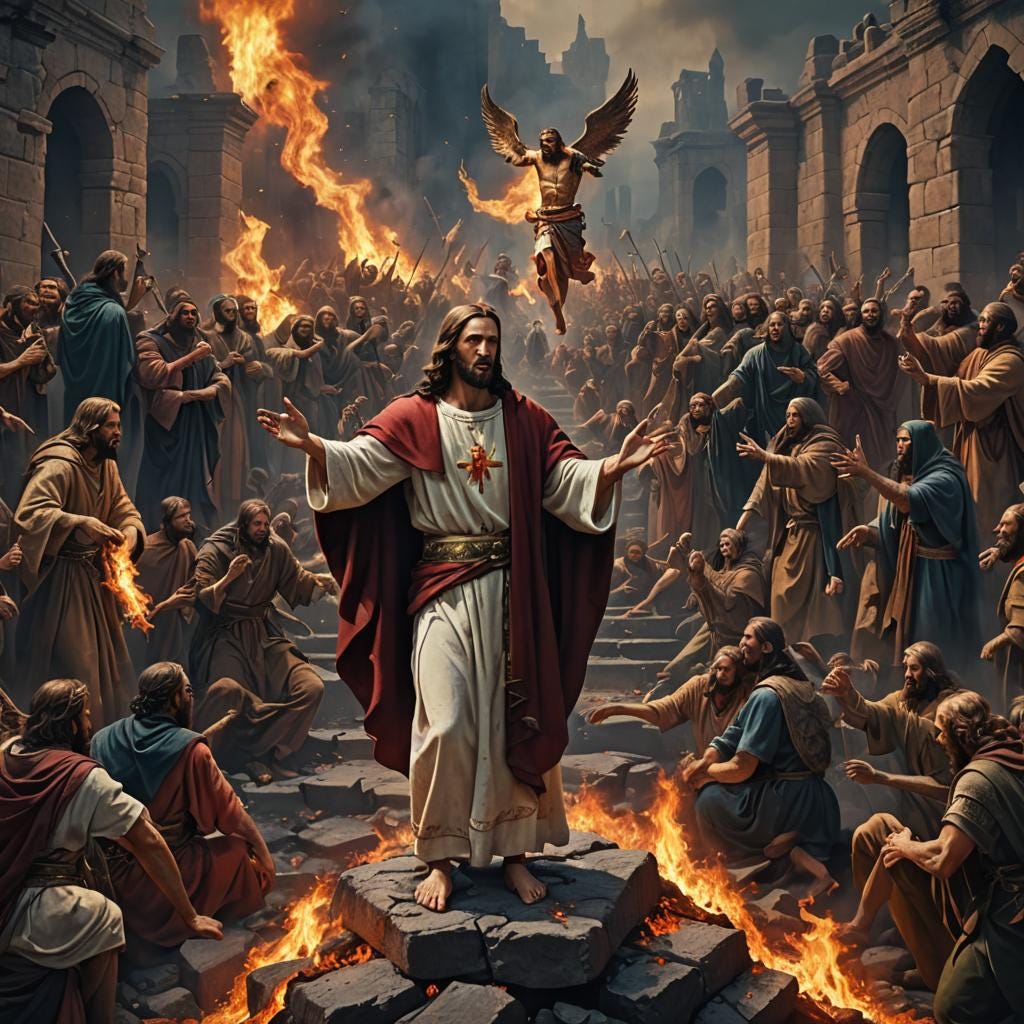
The Transfiguration of Jesus, a pivotal event in the Gospels, reveals a moment where the boundaries between the mortal and divine, the temporal and eternal, and perhaps even the dimensional fabric of reality itself, are blurred. In the Gospel of Matthew, we are told that Jesus took three of His disciples—Peter, James, and John—up a high mountain, where His appearance was radically transformed: “His face shone like the sun, and his clothes became as white as the light” (Matthew 17:2). Moreover, Jesus is seen conversing with two great figures from Jewish history—Moses and Elijah—who appear alongside Him.
This event raises profound theological and metaphysical questions. How can we understand this moment of transference, where Jesus seemingly crosses from the mortal realm into something beyond? Is this transformation symbolic of His divinity, or can we explore it using concepts from modern metaphysics and physics, especially in terms of extradimensionality?
In this article, we will delve into the metaphysical and scientific implications of the Transfiguration, comparing it to the biblical narrative of Jesus’ transition from mortal to immortal through the Resurrection. By considering theories from both physics and theology, we may gain a deeper understanding of what this moment signifies.
The Event of Transfiguration: Crossing Dimensions
The Transfiguration is unique because it offers a glimpse of Jesus as both human and divine simultaneously. His appearance changes dramatically, with His face shining like the sun and His clothes glowing with radiant light, suggesting an interaction with some higher form of reality or dimension. This can be interpreted as a temporary breaking of the veil between the material world and a higher, extradimensional state.
In physics, the idea of multiple dimensions beyond the three spatial dimensions we experience has been a longstanding topic of inquiry, especially in the context of string theory, which posits the existence of up to ten or even eleven dimensions. Most of these dimensions are compactified, meaning they are curled up and imperceptible to human senses, but their existence could potentially explain phenomena that appear to transcend the physical world, much like the Transfiguration.
The glow of Jesus’ face and clothing may symbolize a metaphysical shift into a higher-dimensional state. When viewed in the context of modern science, this could be interpreted as Jesus’ essence transcending the three spatial dimensions and manifesting characteristics of a higher-dimensional reality, where light and matter behave in ways that would be extraordinary from a purely earthly perspective. The laws of physics could differ in these higher dimensions, allowing for phenomena such as radiance or the interaction between beings from different points in history (such as Moses and Elijah) who appear simultaneously.
Theological Perspective: Mortality to Immortality
The Transfiguration also serves as a precursor to the Resurrection, another pivotal moment where Jesus transitions from mortality to immortality. The Resurrection is traditionally seen as Jesus’ definitive victory over death, where He moves from His mortal, perishable state to an eternal, imperishable one. In this sense, both the Transfiguration and the Resurrection are part of the same theological continuum—the revelation of Jesus’ true nature as both fully human and fully divine, who can move between realms or states of existence.
From a theological perspective, the event on the mountain is a revelation of Jesus' true form, an indication that His divine nature transcends earthly constraints. Moses and Elijah, long dead in the physical world, appear alongside Him, suggesting that they too exist in some sort of transdimensional or immortal state. The biblical account emphasizes light—Jesus’ radiant appearance is reminiscent of the descriptions of God’s glory in the Hebrew Scriptures, symbolizing divine presence and power. Light is often used to represent both physical illumination and spiritual enlightenment, pointing to the merging of physical and spiritual realities.
Extradimensional Physics and Divine Metaphysics: A Bridge
The interplay between Jesus’ mortal body and His radiant, divine appearance suggests a moment where He bridges the gap between human experience and divine existence. How can science attempt to explain this?
Higher Dimensions and Transfiguration
In extradimensional theories, such as those proposed in string theory, what we perceive as a solid, three-dimensional reality could be a projection or cross-section of higher-dimensional existence. In these higher dimensions, time, matter, and energy might behave in ways that are completely foreign to us—objects could move without passing through the intermediate points in space, or events separated by time could occur simultaneously.
During the Transfiguration, we might imagine that Jesus momentarily manifests the qualities of a being that exists in more than three spatial dimensions. His radiance could be a form of energy release due to His interaction with dimensions beyond our comprehension, and His conversation with Moses and Elijah may indicate that He is now operating outside the normal flow of time. Both figures are long deceased in our timeline, yet they appear as contemporaries in this higher-dimensional event.
Quantum States and the Nature of the Divine
Quantum mechanics, which deals with particles that can exist in multiple states simultaneously, offers another fascinating lens through which to view the Transfiguration. The duality of Jesus’ nature—fully human and fully divine—can be likened to quantum superposition, where an entity can exist in multiple states at once until it is observed. In this case, the disciples "observe" Jesus in His divine form on the mountain, but He continues to exist in His human state as well. The transition from human to divine (and back again) may be akin to a shift in quantum states, where Jesus’ appearance is the "collapse" of these two realities into one observable form.
The Transfiguration as a Metaphysical and Extradimensional Event
The Transfiguration presents a moment where the boundaries between the mortal and the immortal, the temporal and the eternal, and possibly even the dimensional barriers of our universe, are transcended. Jesus’ radiant transformation can be seen as an indication of His true divine nature, momentarily glimpsed by His disciples, and a foreshadowing of His ultimate passage from mortality to immortality through the Resurrection.
By comparing the biblical narrative with concepts from modern physics—such as extradimensionality and quantum states—we may begin to comprehend the profound mystery of the Transfiguration in new ways. It suggests that Jesus’ divine nature operates in dimensions or realities beyond our current understanding, making this event a fascinating intersection of theology, metaphysics, and the science of the unknown. The Transfiguration remains not only a spiritual revelation but a metaphysical event that challenges our understanding of reality, time, and existence itself.
Further: Extradimensional Physics and the Metaphysical Immortality of Jesus The Extradimensional Physics and Metaphysics of Jesus' Transference from Mortal to Immortal
The transference of Jesus from a mortal human being to an immortal, divine figure—particularly through the events of the Resurrection and Ascension—is one of the most profound mysteries of Christian theology. However, by exploring concepts from modern physics and metaphysics, such as extradimensionality and quantum states, we can attempt to understand this transformation in a new light. In this article, we will explore how Jesus' transition from mortality to immortality might be understood through the lenses of higher-dimensional physics and metaphysical principles.
1. The Resurrection: A Moment of Transformation
In Christian belief, the Resurrection is the event in which Jesus, after being crucified and buried, rises from the dead in a glorified, immortal body. This new body, while physical, displays characteristics that are beyond what is possible for normal human beings. For example, Jesus appears to move through locked doors (John 20:19), disappear suddenly from sight (Luke 24:31), and ascend into heaven (Acts 1:9). These events suggest that His resurrected form operates under different rules of existence than those that govern ordinary human life.
From a metaphysical perspective, this transference from mortal to immortal signifies a dual state where Jesus' physical and spiritual natures converge. His new form is no longer subject to decay, death, or the limitations of time and space. To understand this, we can turn to concepts from extradimensional physics.
2. Higher Dimensions and Immortal Existence
In modern physics, string theory and M-theory suggest that our universe may consist of more than the familiar three dimensions of space and one of time. These theories propose the existence of 10 or 11 dimensions, many of which are compactified or hidden from our perception. While we live in a three-dimensional world, beings or objects in higher dimensions would have access to properties or abilities that transcend our reality.
Transcending Space and Time
Jesus’ ability to pass through walls and appear or disappear at will after His resurrection could be explained through higher-dimensional physics. Just as a two-dimensional being could not comprehend a three-dimensional object passing through its plane of existence, we might not fully comprehend the properties of a being that operates in higher dimensions.
In these extra dimensions, physical limitations such as solid walls might not exist in the same way. For example, a being from the fifth dimension could theoretically "skip" over the three-dimensional obstacles like walls or even time itself. Jesus' resurrected body, operating with these higher-dimensional capabilities, would be free from the constraints of our familiar four-dimensional space-time framework.
In this model, the Resurrection may not just be a return to life but a dimensional elevation—a shift from a finite, mortal existence in the lower dimensions to an infinite, eternal one in higher dimensions.
3. The Immortal Body and Quantum States
Another key framework for understanding Jesus’ transformation is quantum mechanics, which governs the behavior of particles on the smallest scales. In quantum theory, particles can exist in multiple states simultaneously (called superposition) and only “choose” a specific state when observed or measured. This idea offers an intriguing metaphor for the way Jesus’ post-Resurrection body seems to transcend traditional physical states.
Superposition of Mortal and Immortal States
Before the Resurrection, Jesus existed fully as a human, constrained by physical laws, just as any mortal being. After the Resurrection, He exists in a superposition of both mortal and immortal states. His form is physical—He can eat food and be touched, as shown in His interactions with the disciples (Luke 24:42-43)—but He can also transcend the laws of mortality and space-time.
This duality can be seen as a quantum transference where the nature of Jesus' existence has shifted into a higher, more flexible "state." His resurrected body might not be bound to a single quantum state in the way that our mortal bodies are, allowing Him to move freely between the ordinary physical world and a higher-dimensional reality.
Quantum Entanglement and Divine Omnipresence
Another concept from quantum theory, entanglement, suggests that two particles can be connected in such a way that the state of one instantaneously affects the state of the other, no matter how far apart they are. This "non-locality" could offer a way of understanding how Jesus, after His resurrection, was able to interact with the physical world while remaining fundamentally tied to a higher spiritual realm.
Just as entangled particles operate beyond the traditional boundaries of space and time, the resurrected Jesus might have achieved a form of divine omnipresence, able to appear at will and interact with people while being connected to a broader, extradimensional state of being.
4. The Ascension: Entering an Extradimensional Reality
The Ascension of Jesus, where He physically rises into the sky and disappears from sight, could also be interpreted as a dimensional departure rather than a mere spatial one. Rather than moving to a distant location in the sky, Jesus could be moving into a higher dimension that is simply not accessible to the human eye.
In theoretical physics, there is the idea of brane cosmology, where our universe exists on a "brane" (a multi-dimensional membrane) floating in a higher-dimensional "bulk." If Jesus' ascension involved a transition from our brane (the three-dimensional universe) into a higher-dimensional bulk, it would explain His sudden disappearance.
His body, transformed and transfigured into an immortal form, no longer conforms to the traditional three-dimensional space and thus exits into a realm that we cannot perceive. Theologians have long interpreted this as Jesus "returning to the Father" or entering the heavenly realm, but modern physics provides a model for understanding how this might involve an extradimensional transition.
5. Metaphysics of Immortality: Beyond Time and Decay
From a metaphysical standpoint, Jesus’ movement from mortal to immortal is also a journey beyond time and entropy. The resurrection signifies a victory over entropy, the principle in physics that dictates the gradual decay of all things over time. By transcending the mortal state, Jesus enters into an eternal form of existence, which is no longer bound by the decay and death that define human life.
Timelessness and Eternal Life
In Christian theology, immortality means more than just endless life—it refers to a state of existence beyond the confines of linear time. This aligns with the idea that higher dimensions might include a timeless realm. In physics, time is often described as another dimension (the fourth dimension), but in higher dimensions, time as we understand it may not exist or may function very differently.
Jesus' resurrected body, now imperishable, may exist outside the linear flow of time, allowing Him to interact with history at multiple points or even step into and out of time as we know it.
Extradimensional Physics and the Metaphysical Immortality of Jesus
The transference of Jesus from mortal to immortal, especially through the events of the Resurrection and Ascension, can be explored through the frameworks of extradimensional physics and quantum metaphysics. In this view, Jesus’ resurrected body operates in higher dimensions, allowing Him to transcend traditional physical limitations like time, space, and death itself.
The Resurrection might represent a dimensional elevation, where Jesus moves from a finite, mortal existence into an extradimensional, infinite state. His ability to appear and disappear, pass through physical barriers, and ascend into heaven could be understood as a manifestation of higher-dimensional movement, where the constraints of our three-dimensional world no longer apply. Through the lens of metaphysics, Jesus’ immortal form embodies the triumph over decay and the passage of time, offering a glimpse into the nature of eternal life as existence beyond the limits of mortal experience.